Name:
Habitat:
Historical Epoch:
Size and Weight:
Diet:
Distinguishing Characteristics:
About Albertosaurus:
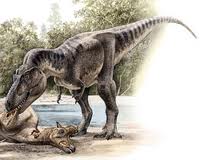
As carnivorous dinosaurs go, Albertosaurus is fairly well known, with multiple, more-or-less complete fossils of this famous tyrannosaur having been dug up in North America (many in the Canadian province of Alberta, after which the genus is named). Unfortunately, it seems to be Albertosaurus' fate to forever be considered a lesser cousin of the slightly biggerTyrannosaurus Rex, which was discovered around the same time (in fact, Albertosaurus was mentioned as a mere "footnote" at the end of one famous T. Rex paper penned by Henry Fairfield Osborn.)
Albertosaurus "only" weighed about two or three tons (compared to more than twice that for the largest T. Rex individuals), but this meat-eater was every bit as dangerous--and, considering its more petite size, possibly faster and nimbler in the pursuit of prey. This tyrannosaur made its living by hunting the numerous herbivorous dinosaurs of the lateCretaceous period, probably making a specialty out of slow-witted hadrosaurs, or duck-billed dinosaurs.
Scarily, paleontologists have found (admittedly inconclusive) evidence that Albertosaurus may have hunted in packs. If this is the case, then not even the armored, full-grown plant eaters of late Cretaceous North America (such as Triceratops) would have been truly safe from being turned into a quick lunch. (By the way, some paleontologists insist that the fearsomely named tyrannosaur Gorgosaurus should properly be classified as a species of Albertosaurus, though not all experts agree.)
1. Allosaurus used to be known as Antrodemus.
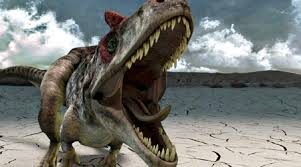
After it was discovered in the late 19th century, Allosaurus bounced around a bit in the classification bins. This dinosaur was first named Antrodemus (Greek for "body cavity") by the famous paleontologist Joseph Leidy, after an obscure anatomical feature, and was only systematically referred to as Allosaurus ("different lizard") starting in the mid-1970's. (See more about the discovery and naming of Allosaurus.)
2. Allosaurus may have preyed on Stegosaurus.
Paleontologists have unearthed solid evidence that Allosaurus preyed on (or at least occasionally tussled with) Stegosaurus: an Allosaurus vertebra with a puncture wound that matches the shape of a Stegosaurus tail spike (or "thagomizer"), and a Stegosaurus neck bone bearing an Allosaurus-shaped bite mark. (For a description of this battle, see Allosaurus vs. Stegosaurus - Who Wins?)
3. The typical Allosaurus lived for about 25 years.
Estimating a dinosaur's life span is always a tricky matter, but based on the voluminous fossil evidence, paleontologists believe Allosaurus attained its full adult size by age 15 (and was thus no longer vulnerable to predation). Barring disease, starvation or thagomizer wounds from angry stegosaurs, this dinosaur may have been capable of living another 10 or 15 years.
4. Allosaurus was one of the instigators of the "Bone Wars."
In their zeal to one-up one another, the 19th-century paleontologists Othniel C. Marsh andEdward Drinker Cope sometimes "diagnosed" new dinosaurs based on too-scanty evidence. Marsh had the honor of coining the genus Allosaurus, but both he and Cope went on to name other, supposedly new dinosaurs that (on further examination) turned out to be separate Allosaurus species.
5. "Big Al" is the most famous Allosaurus fossil.
It was only in 1991--after a full century of Allosaurus discoveries--that researchers unearthed an exquisitely preserved, near-complete fossil, which they promptly dubbed "Big Al." Unfortunately, Big Al didn't live a very happy life: analysis of its bones reveals numerous fractures and bacterial infections, which doomed this 26-foot-long teenaged dinosaur to a relatively early death.
6. Allosaurus regularly shed and replaced its teeth.
Like many predatory dinosaurs (not to mention modern crocodiles), Allosaurus constantly grew, shed and replaced its teeth, some of which averaged three or four inches in length (this dinosaur had about 16 teeth, in both its upper and lower jaws, at any given time). For this reason, it's possible to buy real, fossilized Allosaurus teeth for reasonable prices--only a few hundred dollars each!
7. Allosaurus comprised at least seven separate species...
As mentioned above, the early history of Allosaurus is littered with supposedly "new" dinosaurs that turned out, on further examination, to be separate Allosaurus species. To date, seven species (chief among themAllosaurus fragilis) have been more-or-less accepted by paleontologists, with a dozen or so more considered dubious at best; even still, one suspects that most experts would be happy with just A. fragilis.
8. ...one of which may or may not have been Saurophaganax.
Saurophaganax (Greek for "greatest lizard eater") was a 40-foot-long, two-ton theropod that lived alongside Allosaurus in late Jurassic North America. Pending further fossil discoveries, paleontologists haven't yet decided whether this dinosaur deserves its own genus, or is more properly classified as a new Allosaurus species, Allosaurus maximus.
9. There's no evidence that Allosaurus hunted in packs.
Paleontologists have long speculated that the only way Allosaurus could have preyed on the huge sauropods of its day was if it hunted in cooperative packs. It's a pretty picture, and it would make for a great Hollywood movie, but the fact is that even modern big cats don't team up to bring down full-grown elephants--so Allosaurus individuals probably hunted smaller prey on their own.
10. Allosaurus was one of the first dinosaur movie stars.
The Lost World, produced in 1925, was the first full-length dinosaur movie--and it starred not Tyrannosaurus Rex, but Allosaurus (not to mention Pteranodon and Brontosaurus, the dinosaur later renamed Apatosaurus). It was only a decade or so later, during the King Kongera, that T. Rex supplanted Allosaurus as Hollywood's famous meat-eating dinosaur.
1. The name Giganotosaurus has nothing to do with "gigantic."
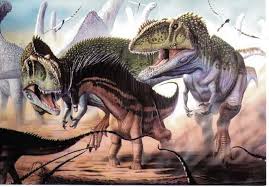
Giganotosaurus (pronounced GEE-gah-no-toe-SORE-us) is Greekfor "giant southern lizard," not "gigantic lizard," as it's often mistranslated (and mispronounced). This common error can partly be traced to prehistoric animals that do, in fact, partake of the "giganto" root--the most notable being the giant oviraptor Gigantoraptor and the giant prehistoric snake Gigantophis.
2. Giganotosaurus may have preyed on Argentinosaurus.
Direct proof is lacking, but the discovery ofArgentinosaurus bones in the proximity of those of Giganotosaurus hints at a predator-prey relationship. Since it's hard to imagine a lone Giganotosaurus taking down a 50-ton Argentinosaurus adult, this may be a hint that Giganotosaurus hunted in packs. (For an analysis of this encounter, see Giganotosaurus vs. Argentinosaurus - Who Wins?)
3. The closest relatives of Giganotosaurus were Carcharodontosaurus and Tyrannotitan.
There's something about giant predatory dinosaurs that inspires paleontologists to come up with cool-sounding names.Carcharodontosaurus ("great white shark lizard") and Tyrannotitan("giant tyrant") were both close cousins of Giganotosaurus, though the first lived in northern Africa rather than South America. (The exception to this rule was the plain-vanilla-sounding Mapusaurus, another Giganotosaurus relative.)
4. Giganotosaurus was discovered by an amateur fossil hunter.
Not all dinosaur discoveries are made by trained professionals. Giganotosaurus was unearthed in the Patagonian region of Argentina, in 1993, by an amateur fossil hunter named Ruben Dario Carolini. The paleontologists who examined the "type specimen" acknowledged Carolini's contribution by naming the new dinosaur Giganotosaurus carolinii.
5. Giganotosaurus was bigger than T. Rex...
Part of what has made Giganotosaurus so popular, so quickly, is the fact that it slightly outweighedTyrannosaurus Rex: full-grown adults may have tilted the scales at about 10 tons, compared to a little over nine tons for T. Rex. Even still, Giganotosaurus wasn't the biggest meat-eating dinosaur; that honor, pending further fossil discoveries, belongs to the northern AfricanSpinosaurus.
6. ...and it was probably faster than T. Rex, too.
There has been a lot of debate lately about how fast T. Rex could run; some experts insist this supposedly fearsome dinosaur could only attain a top speed of a relatively pokey 10 miles per hour. Based on an analysis of its skeletal structure, it seems that Giganotosaurus was a bit fleeter, perhaps capable of sprints of 20mph or more (at least for short periods of time).
7. Giganotosaurus had an unusually small brain for its size.
It may have been bigger and faster than Tyrannosaurus Rex, but oddly enough, Giganotosaurus seems to have been a relative dimwit, with a brain only about half the size of its more famous cousin. Adding insult to injury, to judge by its long, narrow skulll, Giganotosaurus' tiny brain appears to have been the approximate shape and weight of a banana.
8. Giganotosaurus is the largest theropod to be discovered in South America.
Although it wasn't the largest theropod of the Mesozoic Era, Giganotosaurus takes the crown as the largest meat-eating dinosaur of Cretaceous South America. (Fittingly enough, its presumed prey Argentinosaurus holds the title of "largest South American sauropod.") South America, by the way, is where the very first theropod dinosaurs evolved, way back toward the middle Triassic period.
9. To date, no one has found a complete Giganotosaurus skeleton.
As is the case with many dinosaurs, Giganotosaurus was "diagnosed" based on incomplete fossil remains, in this case of a single adult specimen. The skeleton discovered by Ruben Carolini in 1993 is about 70 percent complete, including the skull, hips, and most of the back and leg bones. To date, mere fragments of the skull of a second individual have been found.
10. Giganotosaurus preceded T. Rex by 30 million years.
With all those comparisons based on size, speed, and intelligence, you might imagine that Giganotosaurus was a contemporary of Tyrannosaurus Rex. In fact, this gigantic dinosaur prowled the plains and woodlands of South America about 95 million years ago, a whopping 30 million years before its more famous relative appeared in North America.
1. The original fossils of Spinosaurus were destroyed in World War II.
The German paleontologist Ernst Stromer von Reichenbachdiscovered the remains of Spinosaurus in Egypt shortly before World War I--and they wound up in the Deutsches Museum in Munich, where they were destroyed by an Allied bombing raid in 1944. Since then, experts have had to content themselves with plaster casts of the original Spinosaurus fossils. (Read more about the discovery of Spinosaurus.)
2. Spinosaurus was bigger than T. Rex.
Pending further discoveries, Spinosaurus is the current record-holder in the "world's largest carnivorous dinosaur" category: full-grown, 10-ton adults outweighed Tyrannosaurus Rex by about a ton and Giganotosaurus by about half a ton. Since so few Spinosaurus fossils are extant, it's possible that other individuals were even larger--though for now that's just speculation.
3. The skull of Spinosaurus was unusually long and narrow...
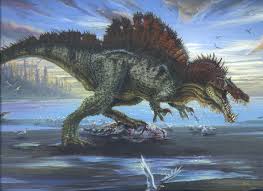
Despite its rough similarity to T. Rex, there was no mistaking Spinosaurus for your average tyrannosaur. Besides its prominent sail (about which more below), Spinosaurus' skull was long, narrow and distinctly crocodilian in profile, and studded with relatively short (but still sharp) teeth. In fact, the skull of Spinosaurus was six feet long, meaning it could have swallowed the average human being whole!
4. ...probably because it fed on fish.
The shape of Spinosaurus' skull--combined with the fact that it lived along the north African shoreline--has led paleontologists to surmise that it (at least occasionally) speared fish out of the water, in addition to hunting down and killing smaller dinosaurs. It's even conceivable that this huge predator pursued a strictly aquatic diet, which would make it the top fisher-lizard of the middle Cretaceous period.
5. The closest relatives of Spinosaurus were Suchomimus and Irritator.
Suchomimus ("crocodile mimic") and Irritator (so named because the paleontologist examining it was having a bad day) both resembled a vastly scaled-down Spinosaurus. In particular, the long, narrow shape of these dinosaurs' jaws hint that they inhabited a similar fish-eating niche in their local ecosystems, the first one in Africa and the second in South America.
6. No one knows why Spinosaurus had a sail...
Over and above its size and the shape of its skull, Spinosaurus' most notable feature was the elongated sail along its back. This sail may have been a sexually selected characteristic (that is, Spinosaurus males with bigger sails had a better chance of mating with females), or it may have helped regulate this dinosaur's body temperature. (For more, see Why Did Spinosaurus Have a Sail?)
7. ...but we do know it was supported by "neural spines."
Spinosaurus' sail wasn't simply a flat, oversized outgrowth of skin that flopped wildly in the Cretaceous breeze and got tangled in dense underbrush. This structure grew on a scaffold of scary-looking "neural spines," long, thin projections of bone--some of which attained lengths of nearly six feet--that jutted out from this dinosaur's individual vertebrae.
8. Spinosaurus may have occasionally tangled with Sarcosuchus.
Spinosaurus shared its northern African habitat with Sarcosuchus, aka the "SuperCroc"--a 40-foot-long, 10-ton prehistoric crocodile. Since Spinosaurus fed mostly on fish, and Sarcosuchus spent most of its time half-submerged in water, these two mega-predators must have occasionally crossed paths. (For more on this encounter, see Spinosaurus vs. Sarcosuchus - Who Wins?)
9. Spinosaurus may have been an occasional quadruped.
Based on the size of its front limbs--much longer than those of a comparable T. Rex--some paleontologists think Spinosaurus may have occasionally walked on all fours. Combined with its piscivorous diet, this would make Spinosaurus a mirror-image of contemporary grizzly bears, which are mostly quadrupedal but occasionally rear up on their hind legs when threatened.
10. Spinosaurus wasn't the only sail-backed dinosaur.
Nearly 200 million years before Spinosaurus, Dimetrodon (not technically a dinosaur, but a synapsid reptile) sported a distinctive sail along its back. And a close contemporary of Spinosaurus was the north African Ouranosaurus, a hadrosaur (duck-billed dinosaur) equipped with either a true sail or a thick, fatty hump of tissue that it used to store fats and liquids (like a modern camel).
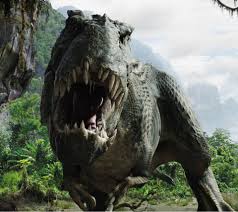
1. T. Rex wasn't the only tyrannosaur.
Tyrannosaurus Rex gets all the press, but the fact is that many other genera oftyrannosaur prowled the Cretaceous landscape, ranging from the tiny, feathered Dilong to the almost T-rex-sizedAlbertosaurus. What these tyrannosaurs had in common was the same basic body plan--a bipedal posture, tiny arms, and big heads with sharp teeth--that set them apart from other theropod dinosaurs (such as raptors).
2. Tyrannosaurus Sue is the world's most complete T. Rex skeleton.
In 1990, fossil hunter Sue Hendrickson discovered an 85-percent complete, full-grown T. Rex skeleton during an expedition in South Dakota. Legal troubles ensued, with the result that Tyrannosaurus Sue was auctioned off to the Field Museum of Natural Historyin Chicago for $8 million, a dinosaur fossil record--while Hendrickson herself hasn't been much heard from since.
3. T. Rex hatchlings may have been covered in feathers.
We all know that dinosaurs evolved into birds, and that some carnivorous dinosaurs (especially raptors) were covered in feathers. Some paleontologists believe that all tyrannosaurs, including T. Rex, must have been covered in feathers at some point during their life cycles, most likely when they first hatched out of their eggs, a conclusion supported by the discovery of feathered tyrannosaurs like Dilong.
4. Tyrannosaurus Rex had an incredibly powerful bite.
Back in 1996, a team of Stanford University scientists determined that T. Rex chomped on its prey with anywhere from 1,500 to 3,000 pounds of force, comparable to a modern alligator, and more recent studies put that figure in the 5,000-pound range. (For purposes of comparison, the average adult human can bite with a force of about 175 pounds). A bite that powerful may have been capable of shearing off a Triceratops' horns! (See T. Rex vs. Triceratops--Who Wins?)
5. T. Rex also had very bad breath...
Granted, most dinosaurs didn't brush their teeth during the Mesozoic Era, and very few of them flossed. Some experts think the shards of rotten, bacteria-infested meat lodged in its numerous teeth gave T. Rex a "septic bite," which may have infected (and eventually killed) wounded prey. The problem is, this process would have taken weeks, by which time some other lucky carnivore would have reaped the kill!
6. ...not to mention a well-developed sense of smell.
Based on the size and shape of its olfactory lobes, T. Rex seems to have had a very sensitive nose, which would have helped it to hone in on living (or, more likely, already dead and rotting) prey. This is the reason some experts think T. Rex was an opportunisticscavenger rather than an active predator, though the evidence either way is far from conclusive.
7. Female T. Rex were bigger than the males.
We don't yet know for sure, but there's good reason to believe (based on the size of existing fossils and the shapes of their hips) that female T. Rex outweighed their male counterparts by a few thousand pounds, a trait known as sexual dimorphism. Why? One reason may be that females of the species had to lay clutches of T. Rex-sized eggs, or perhaps females were more accomplished hunters than males.
8. Tyrannosaurus Rex may have had a warm-blooded metabolism.
Some scientists believe that T. Rex (and other predatory dinosaurs) couldn't have maintained an active lifestyle with a cold-blooded metabolism. The evidence for "endothermy," as a warm-blooded metabolism is called, is slim, but it would help cement the evolutionary relationship between ancient dinosaurs and modern birds. (Not all dinosaurs would have been endothermic; sauropods, for example, probably had a different type of metabolism.)
9. No one knows why T. Rex's arms were so short.
Did Tyrannosaurus Rex use its stunted arms to push itself off the ground after restful naps, or to clasp struggling prey close to its chest? Or is it possible that this predator's arms were completely useless, and would have disappeared entirely (as happened with snakes) after another few million years of evolution? No one has a clue, but for more, see Why Did T. Rex Have Such Tiny Arms?
10. The average Tyrannosaurus Rex lived about 30 years.
It's hard to infer a dinosaur's life span from its fossil remains, but based on an analysis of existing specimens, experts speculate that Tyrannosaurus Rex may have lived as long as 30 years--and since this dinosaur was on top of the food chain, it was most likely felled by old age, disease, or hunger rather than attacks by its fellow theropods.
