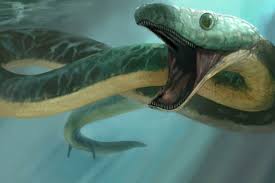
Name:
Habitat:
Historical Period:
Size and Weight:
Diet:
Distinguishing Characteristics:
About Pachyrhachis:
Name:
Habitat:
Historical Period:
Size and Weight:
Diet:
Distinguishing Characteristics:
About Dakosaurus:
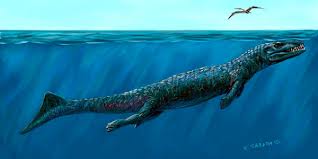
Like its close relatives Metriorhynchus andGeosaurus, Dakosaurus was technically a prehistoric crocodile, even if this fierce marine reptile was more reminiscent of the mosasaurs that appeared tens of millions of years later. But unlike other "metriorhynchids," as these sea-going crocodiles are called, Dakosaurus looked like it was assembled out of the bits and pieces of other animals: its head resembled that of a terrestrial theropod dinosaur, while its long, clumsy, leg-like hind flippers revealed a creature only partly evolved beyond its terrestrial origins. Overall, it seems unlikely that Dakosaurus was a particularly fast swimmer, though it was clearly just speedy enough to prey on its fellow marine reptiles.
For a marine reptile, Dakosaurus has an unusually long pedigree. The first species, initially mistaken for a specimen of Geosaurus, was named way back in 1856, and before that scattered Dakosaurus teeth were mistaken for those of the terrestrial dinosaur Megalosaurus. However, the real Dakosaurus buzz began in the late 1980's, when a new species,Dakosaurus andiniensis, was discovered in the Andes Mountains of South America. One D. andiniensis skull discovered in 2005 was so large and fearsome that it was dubbed "Godzilla" by the excavating team, one paleontologist saying that this dinosaur-like reptile represented "the most drastic evolutionary change in the history of marine crocodiles."
Name:
Habitat:
Historical Period:
Size and Weight:
Diet:
Distinguishing Characteristics:
About Kronosaurus:
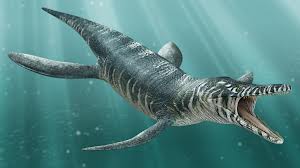
Kronosaurus was a classic example of a pliosaur, marine reptiles characterized by their thick heads, short necks, stocky trunks and outsized flippers. The pliosaur body plan stood in stark contrast to that of their close relatives of the Mesozoic Era, the plesiosaurs (typified by Elasmosaurus andCryptoclidus), which had relatively slender, graceful trunks, long necks and small heads, though often attaining the same impressive lengths.
The middle Cretaceous Kronosaurus appears to have made its living much like a modern Great White Shark, simply eating anything--fish, squids, and other marine reptiles--that swam across its path (the "Kronos" in this giant's name derives from the ancient Greek god, who ate his own children in a zealous attempt to preserve his power). As big as it was, though, Kronosaurus didn't approach the bulk of the most massive pliosaur of all time, Liopleurodon, which may have weighed as much as 35 tons (compared to about 10 tons for the largest Kronosaurus individuals). And both of these reptiles were outclassed by the giant sharkMegalodon, which lived tens of millions of years later and attained weights in the 50 ton range.
As is the case with many other marine reptiles (most notably Mosasaurus), the fragmented remains of Kronosaurus were discovered fairly early in paleontological history, in 1899 in Queensland, Australia (a much more complete specimen was unearthed three decades later, during a fossil-hunting expedition to Australia sponsored by Harvard University). A few decades after that, a second Kronosaurus species was discovered in Colombia, South America, proof that this fearsome reptile attained an especially wide distribution during the Cretaceous period.
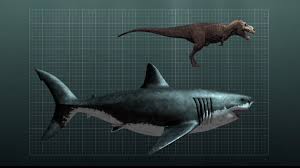
. Megalodon's teeth were about 7 inches long...
Megalodon didn't earn its name ("giant tooth") for nothing. The teeth of this prehistoric shark were over half a foot long, serrated, and heart-shaped (by comparison, the biggest teeth of a Great White Shark are only about three inches long). You have to go back 65 million years--to none other thanTyrannosaurus Rex--to find a creature with consistently bigger choppers, though the canines of some saber-toothed cats also measured up.
2. ...and were once described as "tongue stones."
Because sharks are constantly shedding their teeth--thousands and thousands over the course of a lifetime--Megalodon teeth have been found all over the world, from antiquity to modern times. It was only in the 17th century that a court physician named Nicholas Steno identified peasants' prized "tongue stones" as shark teeth; for this reason, some experts describe Steno as the world's first paleontologist!
3. Megalodon had the most powerful bite of any creature that ever lived.
In 2008, a joint research team from Australia and the U.S. used computer simulations to calculate Megalodon's biting power. The results can only be described as terrifying: whereas a modern Great White Shark chomps with about 1.8 tons of force (and a lion with a wimpy 600 pounds or so), Megalodon chowed down on its prey with a force of between 10.8 and 18.2 tons--enough to crush the skull of a prehistoric whale as easily as a grape.
4. Megalodon may have grown to a length of over 60 feet...
Since Megalodon is known from thousands of teeth but only a few scattered bones, its exact size has been a matter of debate. Over the past century, paleontologists have come up with estimates (based mainly on tooth size and analogy with modern Great White Sharks) ranging from 40 to 100 feet, but the consensus today is that adults were 55 to 60 feet long and weighed as much as 100 tons--and some superannuated individuals may have been even bigger.
5. ...which made it much bigger than prehistoric reptiles like Liopleurodon.
The ocean's natural buoyancy allows "top predators" to grow to massive sizes, but none were more massive than Megalodon. The giant aquatic reptiles of the Mesozoic Era, likeLiopleurodon and Kronosaurus, "only" attained weights of 30 or 40 tons, and a modern Great White Shark can only aspire to a relatively puny 3 tons. The only marine animal to outclass Megalodon is the blue whale, individuals of which have been known to weigh well over 100 tons.
6. Megalodon lunched on giant whales...
Although the bigger-than-Megalodon blue whale is technically a carnivore, it feeds mostly on tiny krill. Megalodon had a diet more befitting an apex predator, feasting on the prehistoric whales that swam the earth's oceans during the Pliocene and Miocene epochs, but also chowing down on dolphins, squids, fish, and even giant turtles (whose shells, as tough as they were, couldn't hold up against 10 tons of biting force). Megalodon may even have attacked the giant whaleLeviathan; see Megalodon vs. Leviathan - Who Wins? for an analysis of this epic battle.
7. ...and may have disabled them by biting off their fins.
According to at least one analysis, Megalodon's hunting style differed from that of modern Great White Sharks. Whereas Great Whites dive straight toward their prey's soft tissue (say, a carelessly exposed underbelly), Megalodon's teeth were suited to biting through tough cartilage, and there's some evidence that it may have first sheared off its victim's fins (rendering it unable to swim away) before lunging in for the final kill.
8. Megalodon's closest living relative is the Great White Shark.
Technically, Megalodon is known as Carcharodon megalodon--meaning it's a species (Megalodon) of a larger genus (Carcharodon). Also technically, the modern Great White Sharkis known as Carcharodon carcharias, meaning it belongs to the same genus as Megalodon. However, not all paleontologists agree with this identification, claiming that Megalodon and the Great White arrived at their striking similarities via the process of convergent evolution.
9. Megalodon fossils have been found all over the world.
Unlike some marine predators of prehistoric times--which were restricted to the coastlines or inland rivers and lakes of certain continents--Megalodon had a truly global distribution, terrorizing whales in warm-water oceans all over the world. Apparently, the only thing keeping adult Megalodons from venturing too far toward solid land was their enormous size, which would have beached them as helplessly as 16th-century Spanish galleons.
10. No one knows why Megalodon went extinct.
So Megalodon was huge, relentless, and the apex predator of the Pliocene and Mioceneepochs. What went wrong? Well, there's no lack of theories: Megalodon may have been doomed by global cooling (which culminated in the last Ice Age), or by the gradual disappearance of the giant whales that constituted the bulk of its diet. (By the way, some people think Megalodons still lurk in the ocean's depths, as detailed in the Discovery Channel special Megalodon: The Monster Shark Lives, but there's absolutely no reputable evidence to support this. See this review for more about this made-up "documentary.")
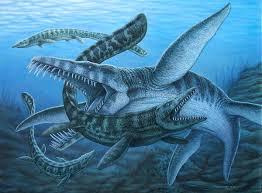
The genus name Liopleurodon was coined byHenri Émile Sauvage in 1873 on the basis of very poor remains consisting of three 70 millimeter (2¾ inch) teeth. One tooth, found near Boulogne-sur-Mer, France in layers dating from the Callovian, was namedLiopleurodon ferox, another from Charly, France was named Liopleurodon grossouvrei, while a third discovered near Caen, Francewas originally described as Poikilopleuron bucklandi and ascribed by Sauvage to the species Liopleurodon bucklandi. Sauvage did not ascribe the genus to any particular group of reptiles in his descriptions.[2]
Liopleurodon fossils have been found mainly in England and France, with one younger species known from Russia. Fossil specimens that are contemporary (Callovian) with those from England and France referrable to Liopleurodon are known from Germany.[3]
Currently, there are two recognized species within Liopleurodon. From the Callovian of England and France L. ferox is well known; while also from the Callovian of England is the rarer L. pachydeirus, described by Seeley as a Pliosaurus (1869).[4] Only L. ferox is known from more or less complete skeletons.
Palaeobiology[edit]
Four strong paddle-like limbs suggest that Liopleurodon was a powerful swimmer. Its four-flipper mode of propulsion is characteristic of all plesiosaurs. A study involving a swimming robot has demonstrated that although this form of propulsion is not especially efficient, it provides very good acceleration - a desirable trait in an ambush predator.[5][6] Studies of the skull have shown that it could probably scan the water with its nostrils to ascertain the source of certain smells.[7]
Size[edit]
Estimating the maximum size of Liopleurodon has become a controversial subject. The palaeontologist L. B. Tarlo suggested that the total body length of a pliosaur (including Liopleurodon) can be estimated from its skull length. Tarlo claimed that the skull of a pliosaur is typically about one-seventh of the total body length. The largest known skull belonging to L. ferox is 1.54 metres (5.1 ft) long.[8]According to Tarlo's hypothesis, this specimen would be around 10.5 metres (34 ft) long. However, the case of Kronosaurus exposed some uncertainty about the accuracy of Tarlo's suggestion.[9]

New research on pliosaur anatomy has cast doubt on Tarlo's hypothesis for estimating the size of pliosaurs and revealed that pliosaur skulls were typically about one-fifth of the total body length. An exceptionally well-preserved skeleton of L. ferox is on display in the Institut und Museum für Geologie und Paläontologie der Universität Tübingen in Germany. This specimen is around 4.5 metres (15 ft) long.[10] Fossil remains of another specimen identified as L. ferox have been excavated from an Oxford Clay formation nearPeterborough. This specimen has been estimated to be 6.39 metres (21.0 ft) in length with a skull length of about 1.26 metres (4.1 ft) and is regarded as an adult individual.[1]An adult L. ferox would have averaged 5–7 metres (16–23 ft) long.[9]
Some fossil remains excavated from the Kimmeridge Clay formation in England indicate a much larger taxon, possibly up to 15 metres (49 ft) long. However, these have not been assigned to the genus Liopleurodon.[9]
A partial specimen of a jaw mandible measuring 2.875 metres (9.43 ft) is on display in the Oxford University Museum of Natural History: it is estimated that the total length of the jaw is in excess of 3 metres (9.8 ft). The specimen was originally assigned to the genusStretosaurus (as Stretosaurus macromerus),.[11] Stretosaurus later became a junior synonym of Liopleurodon.[12] However, it was later re-classified as Pliosaurus macromerus.[13]
In 1999, Liopleurodon was featured in an episode the BBC television series Walking with Dinosaurs, which depicted it as an enormous 25 m (82 ft) long animal. However, this is not considered to be accurate for any species of Liopleurodon.[9]
Taxonomy[edit]

Liopleurodon belongs to the family Pliosauridae, a clade within Plesiosauria, known from the Jurassic (maybe also from the Cretaceous) of Europe and North America.[14]
Liopleurodon was one of the basal taxa from the Middle Jurassic. Differences between these taxa and their relatives from the Upper Jurassic include alveoli count, smaller skull and smaller body size.[8]
An analysis in 2013
